Slipknot
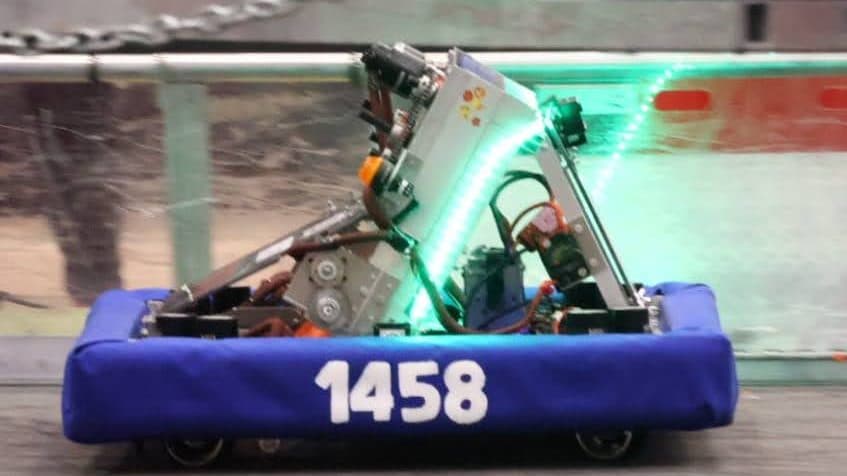
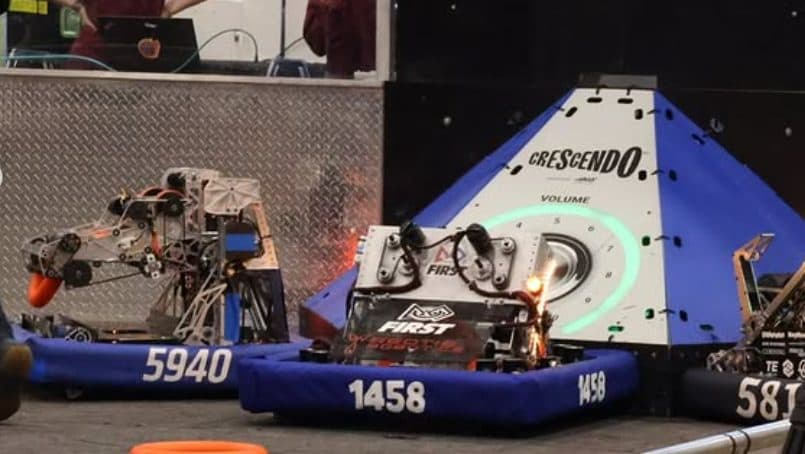
FRC 2024 robot that reached the World Championships on a four-note autonomous.
- Year
- 2024
- Category
- robotics
- Built at
- FRC Team 1458
- Team
- 7 people
Stack
- Problem
- Fifteen seconds of autonomous, and the scoring cycle is: shoot what you are holding, drive to a note, pick it up, drive back, shoot.
- Approach
- One state machine, two jobs.
- Result
- Second alliance at the East Bay Regional, knocked out in the finals, and the season ended at the FRC World Championships — the only one of the team's three robots in this portfolio to get there.
Team 1458's robot for the 2024 FRC season, CRESCENDO, and the one that went to the World Championships. Mechanically it was the opposite of the year before: the pneumatics were gone, the mass came down, and the centre of mass came with it. In software that bought something specific — a robot that could be asked to drive a path and shoot on the way, and would actually arrive.
The problem
Fifteen seconds of autonomous, and the scoring cycle is: shoot what you are holding, drive to a note, pick it up, drive back, shoot. Four notes means that cycle four times with no human in the loop, and every stage of it can fail silently. The note does not always get picked up. The flywheels do not always reach speed before the feeder pushes. A path that assumes the last one finished cleanly starts from the wrong pose.
A routine written as a list of timed steps handles none of that. It handles the run where everything works, and on the run where the note slips it keeps going anyway and scores nothing for the rest of the period.
Architecture
One state machine, two jobs. StateMachine<S> is thirty lines: a map from a state to a
function of elapsed milliseconds, returning the next state or null to stay. Three helpers
build the states that come up — addTimerState for "do this for N ms then move on",
addBoolState for "do this until the condition holds", addOffState for a terminal state.
That is the whole abstraction, and it drives both the teleoperated shot sequence and every
autonomous routine, which means the autonomous is built out of pieces that have been running
all match rather than out of code that only executes in the first fifteen seconds.
The four-note autonomous is sixteen states over eight trajectories. NonGoofyCenterAuto
alternates in-and-out PathPlanner paths (InN2/OutN2, InN3/OutN3, …) with shoot states,
and the transitions are conditions rather than clocks: a shoot state ends when the IR
beam-break says the note has left, an approach state ends when the trajectory reports it has
finished sampling. The intake runs only after a per-path settling delay, tuned separately
per note, so the feeder is not dragging against a note that has not seated yet.
Shot readiness is measured, not waited for. Shooter runs two TalonFX flywheel motors
under Phoenix 6 VelocityVoltage with a velocity-feedforward gain, and shooterRampedUp()
reports true when the mean measured wheel speed passes 90 rps. The speaker shot transitions
SPIN_UP → SHOOT on that signal; the fixed 1500 ms timer version of the same transition is
still in the file directly above it, commented out. That one-line change is the difference
between a shot that is on time and a shot that is on schedule.
An interface, so manual and automatic are not two copies. IFS — intake, feeder,
shooter — is a four-method interface with two implementations. IFSManual maps controls
straight through; IFSAuto puts the same subsystems behind three state machines, one per
shot type (speaker, amp, and a max-power shot), and adds the operator overrides that matter
at competition: an intake override for when the beam-break is lying, and live amp-speed trim
on the second controller's D-pad.
Hand-rolled PID with the two terms that were actually needed. swervedrive/PID decays
the integral term instead of accumulating it without bound, and clamps output slew to a
configured maximum acceleration. Every gain is readable and writable from SmartDashboard, so
tuning happened between matches rather than between builds.
What did not work
The autonomous was never finished, only improved. The commit trail is the honest record of it: "Auto sorta-ish not working" on April 2, "3-Note Auto (not consistent needs tuning)" and "4 Note auto worked once" on April 4, and "WORKING CODE: 4 NOTE AUTO" seventeen days later. Between those two dates the routine did not get a new design; it got accuracy, one note at a time.
What made it inconsistent was that the errors were not constant. Each note in the sequence sits further from the starting position than the last, so each one gives the drivetrain more distance to accumulate heading and translation error before the intake has to be in the right place — and the carpet it accumulated that error on was not the same carpet twice. A routine tuned on the practice field did not reproduce on a competition field, and a routine tuned for three notes did not simply extend to four.
That shows up in the code as numbers that grow. The settling delay before the intake is allowed to run is tuned per note rather than shared: 900 ms on the first, 1250 ms on the second, 1350 ms on the third, and none at all on the fourth, where the approach is long enough that the note has already seated. Those four constants are what three weeks of iteration produced, and they are the reason the routine works at four notes rather than scoring one and then dragging the intake against a note that had not arrived yet.
Measured results
Second alliance at the East Bay Regional, knocked out in the finals, and the season ended at the FRC World Championships — the only one of the team's three robots in this portfolio to get there.
The robot also came in under the competition weight limit, which the 2023 and 2025 robots did not: both of those ran at the cap. That is the whole of what "lighter" means here — the actual figures are not recorded anywhere Victor still has.
Figures