Lemonlight
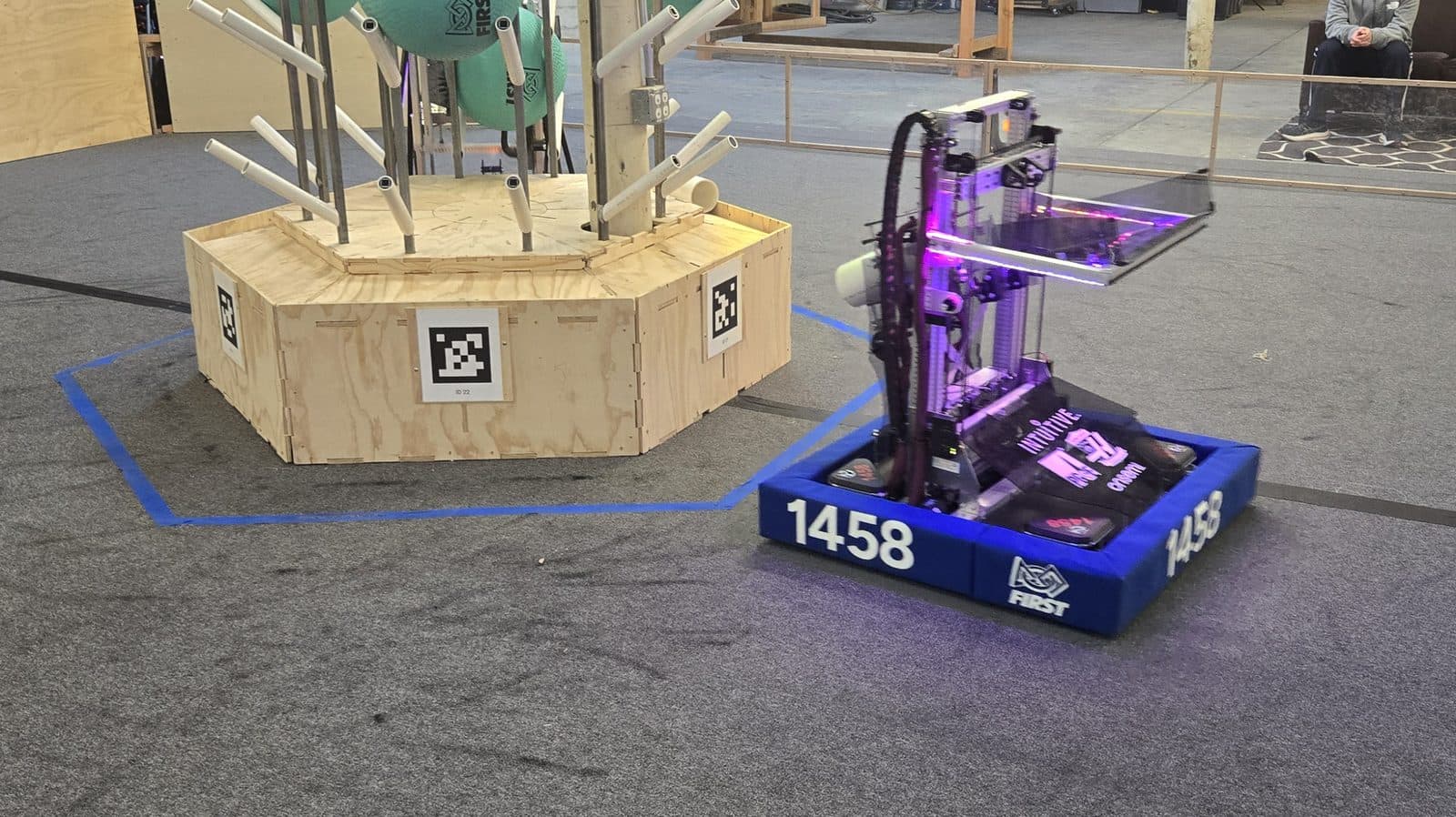
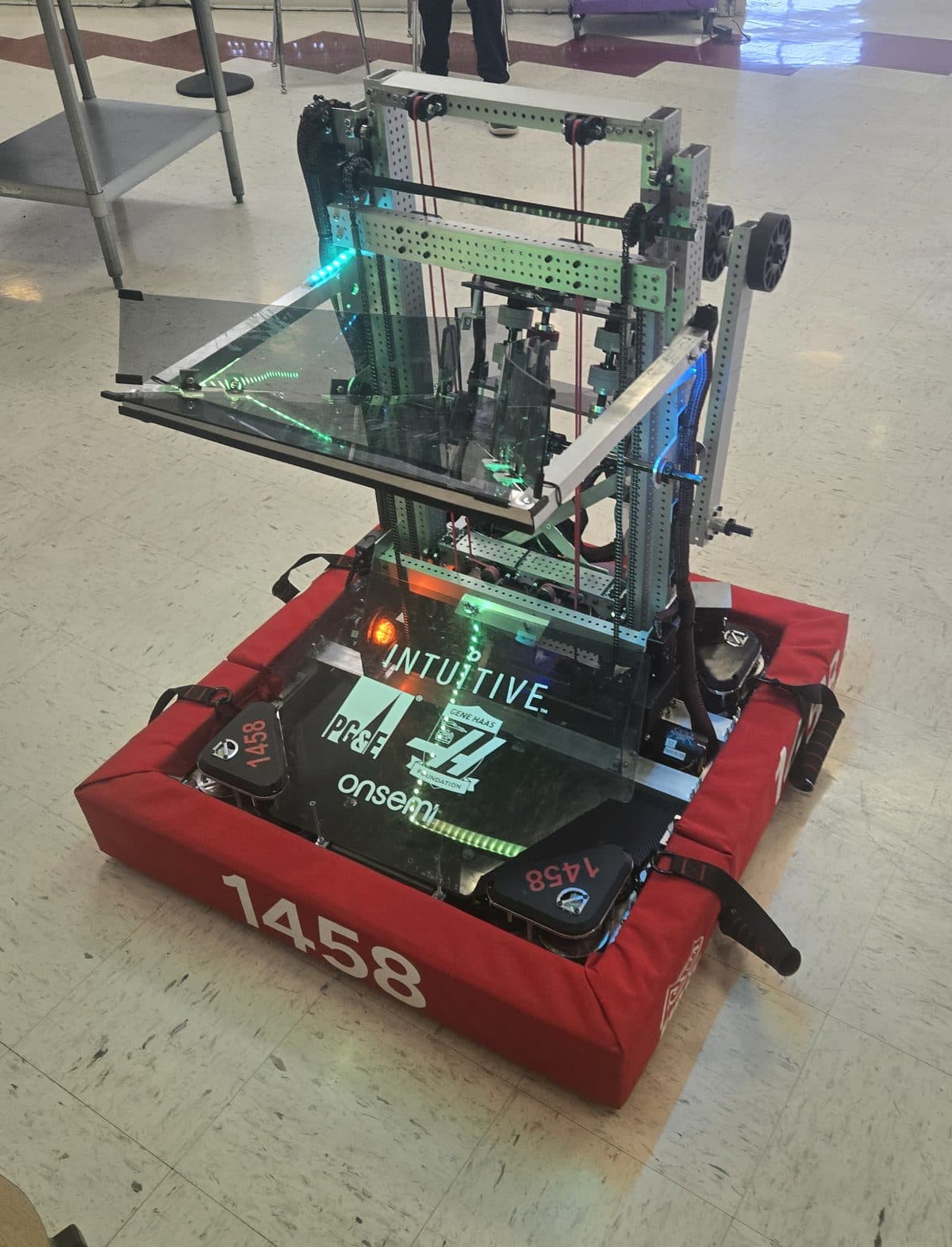
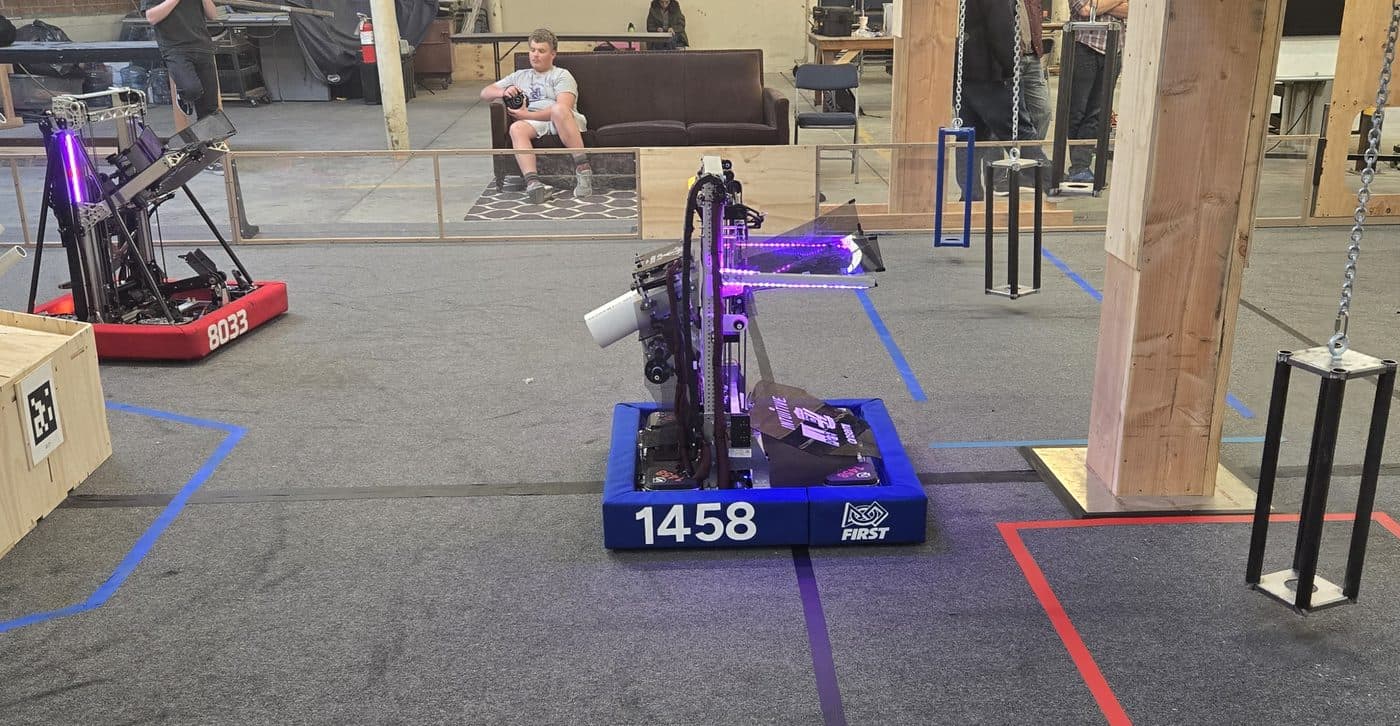
FRC 2025 robot with a Motion Magic elevator and runtime-generated AprilTag approaches.
- Year
- 2025
- Category
- robotics
- Built at
- FRC Team 1458
- Team
- 14 people
Stack
- Problem
- Scoring on the reef is a two-axis problem that has to close in about a second and a half.
- Approach
- The elevator is a Motion Magic position loop, not a speed.
- Result
- 13th of 35 at the Pinnacles Regional and 19th of 41 at the San Francisco Regional.
Team 1458's robot for the 2025 FRC season, REEFSCAPE. The codebase is a different animal from the two before it — roughly 12,700 lines across 100 files against the previous year's 3,400, rebuilt around a subsystem-and-looper architecture with its own odometry, motion planning and vision stack. Victor's share of it was the elevator, the coral scoring actions and the teleop bindings that drive them.
The problem
Scoring on the reef is a two-axis problem that has to close in about a second and a half. The robot has to be at the right place relative to an AprilTag, and the elevator has to be at the right one of four heights, and neither can wait for the other. Get the order wrong and the carriage swings into the reef; run the elevator while a coral is still crossing the intake and it jams against the frame.
The elevator is also the part of the robot with the most stored energy and the shortest distance to a broken mechanism. Driving it open-loop means every height is the driver's thumb and the top of its travel is whatever stops it.
Architecture
The elevator is a Motion Magic position loop, not a speed. Two Krakens run as a
leader-follower pair under Phoenix 6 MotionMagicVoltage, profiled at 40 rps cruise, 72.5
rps² acceleration and a jerk limit, with position gains on slot 0 and a static feedforward
term for the friction it has to break out of. Eight named setpoints — ground, L2, L3, L4, the
algae presets and a default height chosen to clear the reef without blocking the front camera
— are addressed by name rather than by number, so the same height means the same thing in
teleop and in autonomous. "At target" is a half-rotation tolerance read off a value cached in
readPeriodicInputs, not a live motor query, because the callers are on other threads.
Three interlocks, each guarding a different failure. The move is refused outright while
the intake LaserCAN reads under 100 mm — a coral in the throat means the elevator does not
go anywhere. A mSafeStop flag is raised on every enable, so a robot powered on mid-cycle
holds position rather than driving to a target left over from the last match. A bank of
magnetic switches on DIO 0–4 backs the encoder at ground, L2, L3, L4 and the algae position,
and was live at competition — an encoder that has drifted still reports a plausible number,
and these are the sensors that do not. Stator and supply current are both limited to 40 A,
which is what turns a jam into a stall instead of a fire.
Autonomous routines are a string. AutoStringAuto parses a small language into nested
actions: bare tokens name field points and generate the trajectory between them, brackets
run actions in parallel, parentheses in series, braces repeat, and CIntake, CShoot,
Elevator 4 and Snap LEFTBAR are the verbs. A new routine is a new string, which means it
can be changed between matches by someone who is not editing Java.
Approaches are generated at runtime, not drawn in advance. SnapToTag takes an offset
name — left bar, right bar, centre, coral station, hang — looks up the nearest matching
AprilTag from the field layout, and builds a PathPlanner path from the robot's current pose
to that offset, with its own constraints zone for the final approach. The same action is
bound to the driver's bumpers in teleop and dropped into autonomous strings unchanged.
Faster swerve, deliberately. The drivetrain is SDS MK4i on Kraken X60s at the L3 drive ratio — the fast option of the three — with the module constants pulled from a shared table rather than transcribed. Pose comes from a wheel tracker fused with a multi-camera vision manager that runs candidate poses past an acceptor before they are allowed to move the estimate.
What did not work
The binding constraint on this robot was not a control problem. It was time on the hardware. Mechanical failures — the arm broke, among others — took the robot out of service repeatedly during a six-week build, and every hour it spent being repaired was an hour the elevator could not be tuned on. Software that closes a loop around a physical mechanism cannot be finished away from it: the gains, the setpoint heights and the current limits are all numbers that only the real machine can tell you, and they were found in whatever windows the robot was actually assembled.
What that cost is legible in the constants file, which still carries "occasionally stalls at bottom" beside the ground height and "stalls at top" beside L4. Both are the profile pushing against a hard stop it was never given time to be trimmed away from, and both were shipped rather than fixed, because the alternative was not shipping an elevator.
The move to closed loop happened in that same compressed window — "switched to PID based system (untested)" on February 18, "elevator pid" the next day, "Elevator Working" on the 22nd. Four days from an untested rewrite to a working mechanism is fast, and it is fast because there was no slower option available.
Measured results
13th of 35 at the Pinnacles Regional and 19th of 41 at the San Francisco Regional.
The robot ran at the maximum allowed weight, as the 2023 robot did. Of the team's three robots in this portfolio, only the 2024 one came in under the cap.
Figures